
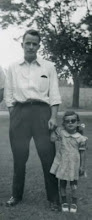
They thought they had locked up the memories and thrown away the key.
Talking meant remembering, so many veterans of World War II didn't speak about the scenes of carnage and combat they saw more than 60 years ago. Not even to their wives or children.
Suck it up, lock it away -- from an article in the Cleveland Plain Dealer - 7/16/09
World War II veterans are still exhibiting symptoms of PTSD 65 years after the end of the war. Of the 2.5 million WWII veterans still alive today, estimates range from 20 to 30 percent of them suffer from PTSD. Some of them have had PTSD symptoms ever since the war, but many are recently experiencing them - some because of loss of a spouse, others due to retirement, and a number due to dementia, wherein long ago memories remain, while the short term memories are difficult to retain.
The WWII veterans should be helped and in doing so, more information will be available to help the subsequent group of veterans, especially the large number of Vietnam vets who are already in their sixties.
Click on title for link.
Sunday, July 19, 2009


Monday, July 13, 2009
The Untold Story of the Greatest Generation's Trauma
A portion of Thomas Childers' article from the Boston Globe on Father's Day, June 2009:
(quoted extensively for educational purposes)
My father Tom Childers and Willis Allen, my best friend Gary’s father, were veterans of the Second World War, prototypes of what we have come to call “the Greatest Generation.” Raised in modest circumstances during the Great Depression, with little in the way of social or economic advantages, they fought and survived the war, returned home, had families, and built successful careers. They prospered, joined social clubs, watched their sons play Little League, took their families on vacations to Florida. They were model veterans, model family men.
But for Tom and Willis and many other men who returned from World War II, there was another, more complex and unsettling reality that lurked below the glossy surface of the Greatest Generation storyline. The men and women of that generation deserve all the testimonials they receive, but the uncomplicated, reassuring portrayal of their experiences found in Tom Brokaw’s best-selling book and in our public discourse has become more than a tribute to a passing generation; it has become our public memory of “the good war” and its aftermath. Indeed, it has been repeated so often in public commemorations that it has become almost an incantation, more liturgical than historical.
I thought of Willis and Tom earlier this month as I watched dignitaries and aged veterans gather in Normandy to commemorate the fateful D-Day landings of June 6, 1944. Never mentioned in such ceremonies or in the vast media attention devoted to the “Greatest Generation” is another battle our fathers waged. That battle was not fought in the fields of Europe or the jungles of the South Pacific but in towns and cities all across America, sometimes in highly public spaces - hospitals and courtrooms - but more often in parlors, kitchens, and bedrooms. As many veterans and their families would discover, the last daunting challenge of the war, for those fortunate enough to survive it, was attempting to resume a life interrupted and forever changed by war.
I wonder how many of us were part of the war our fathers continued to fight in the isolation of our homes.
Click on the title for a link to the entire article
Tuesday, June 30, 2009
A New Generation of Children Suffers
This USA Today article outlines how at least a quarter of the children of today's soldiers are suffering from the effects of their fathers' or mothers' war. Behavior problems and depression are associated with the family strains brought about by multiple deployments. The author states that programs to help are available, but few ask for help. I question whether it is known that programs are available, and how accessible they are to the families.
Click on title for link.
Click on title for link.
Thursday, May 28, 2009
Invisible Wounds That Kill
This touching article published in the Philadelphia Inquirer (click on title of post for link) on Memorial Day 2009 articulates how the hidden traumas of World War II haunted a survivor of Okinawa so that even though he physically returned from the war, he never really came home. Marvin Ravinsky, who died alone and destitute, finally received honor and recognition. The author of this article, Chris Gibbons, respectfully gives tribute to the warrior who was forgotten and isolated during his life.
Monday, May 25, 2009
Soldier from the War Returning - The Greatest Generation's Troubled Homecoming
Thomas Childers, Professor of History at the University of Pennsylvania, has written a book, with the above title, from the heart. He details the truth about the return of World War II veterans. Using both his personal story, which includes his father's return from England and the death of his maternal uncle in the last bomber shot down over Germany before VE day (written about in Wings of Morning), he articulates the truth that many of we children of World War II veterans have discovered - that even if our fathers came home physically whole, there were invisible wounds from the war that we intuited, but were not able to put voice to for many years. He also thoroughly details the high unemployment and the high divorce rate after the war. A great read if you want to discover the not so rosy homecoming of the Greatest Generation.
The NPR show Here and Now broadcast an interview with the author on Memorial Day, May 25, 2009. (click on title for a link to the show's site.
The NPR show Here and Now broadcast an interview with the author on Memorial Day, May 25, 2009. (click on title for a link to the show's site.
Thursday, March 19, 2009
Soft Spots - Universality of the Combat Veteran's Trauma
I completed Soft Spots by Clint Van Winkle. It is a wonderfully written book, weaving war experiences in Iraq with his continuing flashbacks after he returns home. I found especially enlightening what he wrote about his World War II grandfather, since it mirrors what my WWII veteran father told me about the lasting impact of war, even World War II, the "Good War"
Excerpt from the book:
My grandpa never talked about World War II to anyone. The family knew he had served in the Army but not much else. After I became a Marine, he started to tell stories about his war to me. It was a "good war" -- the other "war to end all wars" that didn't end any wars. I found out he served overseas for three years, dug fighting holes in occupied Berlin, got into bar fights in France, and spent time in Wales. He talked about going and coming, his Army buddies and training, but never got into the stuff I really wanted to know. Had he ever killed anybody....
When I got back from Iraq, and saw my grandpa, we talked about war again. However, we talked about it in a different manner than we had years earlier. We talked about the places we saw and the friends we gained. We bypassed the death and shooting. Our wars were sixty years apart but weren't really any different. It didn't matter how many years separated our wars or where we traveled to fight them. Blood still dried the same way around wounds and charred bodies still crusted over the same as they always have. It didn't matter that he'd fought in a "good war" and I fought in a controversial war; because the effect turned out to be the same: Neither of us could find anything praiseworthy about combat.
The Real World Brooklyn and Iraq
Today's combat veteran
A small-town Pennsylvania boy with a laid-back personality, Ryan has had his share of action. After enlisting in the army at the age of 17, he served in Iraq and got an eyeful. Now 23, he has returned from his duty with a newfound appreciation for life and a better perspective on the world around him, despite having lived through many near-death experiences, as well as the death of a close friend. A class clown who juggles his time between amateur filmmaking, guitar playing and pranking those around him, Ryan is currently in his first-ever relationship.
A small-town Pennsylvania boy with a laid-back personality, Ryan has had his share of action. After enlisting in the army at the age of 17, he served in Iraq and got an eyeful. Now 23, he has returned from his duty with a newfound appreciation for life and a better perspective on the world around him, despite having lived through many near-death experiences, as well as the death of a close friend. A class clown who juggles his time between amateur filmmaking, guitar playing and pranking those around him, Ryan is currently in his first-ever relationship.
Subscribe to:
Posts (Atom)